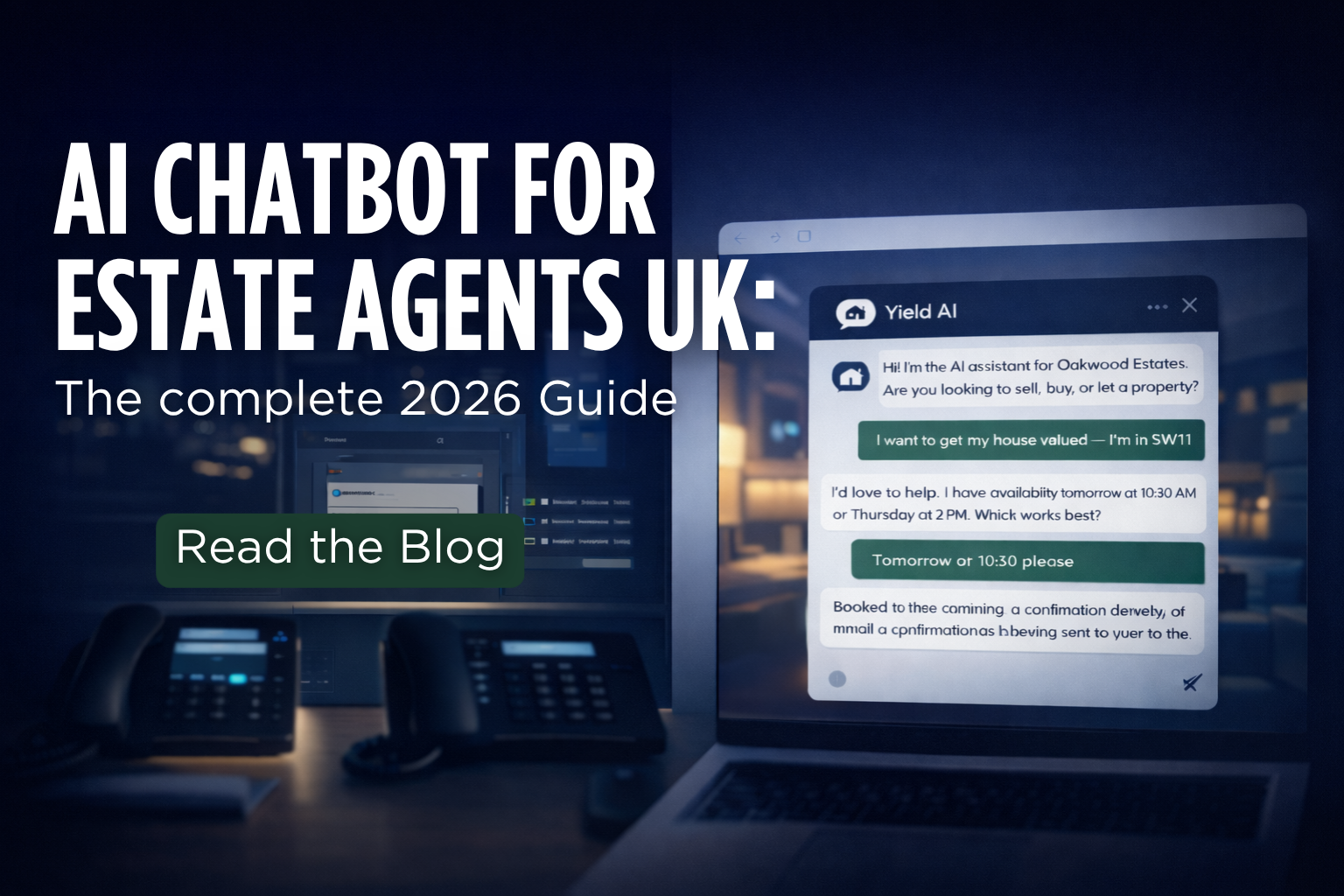
AI chatbot for estate agents UK: the complete 2026 guide
Estate agents across the UK are sitting on a lead generation problem that has nothing to do with traffic. They have visitors. They have intent. What they often don't have is a mechanism that captures that intent when no one is in the office — and qualifies it before it lands in an inbox.
The AI chatbot for estate agents has become the shorthand answer to that problem. But the category has matured significantly in 2025 and 2026, and "chatbot" undersells what the best platforms actually do. This guide covers the full landscape: what the technology does, how to evaluate it, how it fits alongside existing agency tools, and where UK estate agents are seeing the clearest return.
The problem the technology is solving
The UK residential property market moves on time and information. A buyer who finds the right property on a Tuesday evening wants to book a viewing on Tuesday evening — not to fill in a form and wait until Wednesday morning for a callback. A vendor browsing your site after hours is comparing you against three competitors simultaneously. If your website can't respond, one of those competitors will.
The average UK estate agency website converts between 1.5% and 3% of visitors into enquiries. That number hasn't moved significantly in years — not because agencies lack traffic, but because the conversion mechanism hasn't kept pace with when and how buyers and sellers actually behave online.
AI chatbot technology for estate agents addresses this at the point of intent: the moment a visitor is on your site, actively engaged, and ready to act.
How AI chatbots for estate agents work in 2026
The technical architecture behind modern estate agent AI tools has changed substantially from the rule-based systems of 2019–2022. Today's platforms are built on large language models capable of understanding the nuance, intent, and context of a property conversation — including the things that make property conversations genuinely complex.
A buyer asking about a property might reference their current chain position, ask about school catchment in the same sentence as the parking situation, and want to know if the vendor would accept an offer before completing on their own sale. A 2019 chatbot would have routed that to a human. A 2026 AI agent handles it, qualifies it, and books the next step.
The practical workflow on a well-implemented platform looks like this:
1. A visitor lands on the agency website — at any hour.
2. The AI agent opens a contextual conversation based on the page they're viewing.
3. It qualifies the visitor's intent: buyer, vendor, landlord, tenant, or investor.
4. It collects relevant qualification data: buying position, budget, timeline, requirements.
5. It either books a viewing or valuation directly, or routes a qualified lead to the appropriate team member.
6. The agency receives a complete conversation record, not just a name and phone number.
The after-hours case: where AI pays for itself fastest
The economics of AI chatbots for UK estate agents are clearest in the after-hours use case. Typical residential agency website data shows that between 30% and 45% of engaged traffic — visitors who spend meaningful time on the site — arrives between 6pm and midnight. This is peak intent time: people browse property after work, make decisions on Sunday evenings, and prepare viewing lists on Friday nights.
That traffic hits one of two outcomes without an AI agent: a contact form with a 24-hour response lag, or a phone number that nobody answers. The conversion rate on both is low. The frustration rate is high.
An AI agent that converts 8–12% of after-hours visitors — a realistic figure for a well-tuned platform — generates three to five times more leads from traffic that previously went nowhere. For most independent agencies, that's the payback case.
AI chatbot vs live chat: which is right for estate agents?
Live chat — real humans responding to website enquiries in real time — was the previous generation answer to the after-hours problem. It solves the response gap but introduces its own constraints: staffing costs, coverage gaps, quality inconsistency, and the inability to scale during high-traffic periods.
AI-powered chat addresses all of those constraints, but the comparison isn't purely binary. Some platforms blend both — using AI for initial qualification and routing to a human for complex conversations. The right configuration depends on agency size, staffing model, and the complexity of the enquiries the website typically receives.
For most independent and regional UK agencies, a fully AI-powered agent handles the full enquiry cycle without human intervention. The occasions when a conversation requires a human — legal complexity, unusual property situations, complex negotiation — are genuinely rare at the website enquiry stage.
Material information and compliance: an emerging use case
Beyond lead capture, AI agents are beginning to play a role in compliance workflows. The Material Information regulations introduced under the National Trading Standards guidance require estate agents to provide specific information upfront in property listings — tenure, service charges, council tax band, and a growing list of property-level data points.
An AI agent on an agency website can collect and surface this information conversationally, helping both visitors and the agency itself maintain compliance without additional administrative overhead. This is an area where the technology is still maturing, but early adopters are using AI to reduce the manual effort involved in Material Information compliance.
Deploy IQ and Yield: how we approach this
Deploy IQ builds AI systems for the property industry. Yield, our product for estate agents, is an online AI agent designed specifically for UK residential and lettings agencies. It's not a repurposed generic chatbot — it's built around the specific workflows, terminology, and qualification requirements of estate agency.
Yield handles buyer and vendor qualification simultaneously, integrates with common diary and CRM systems, and operates as a subscription service rather than a per-lead model — which means agencies with strong organic traffic aren't penalised for their own SEO success.
The broader Deploy IQ platform also includes Onyx, our AI system for property investors, developers, and land promoters — covering the commercial and investment side of the market where AI is transforming pipeline management, site tracking, and investor reporting.
What the data says about AI adoption in UK estate agency
Adoption of AI tools in UK estate agency accelerated significantly through 2024 and 2025. The agencies moving fastest tend to share three characteristics: they have established websites with organic search traffic, they operate across sales and lettings (making the dual qualification capability particularly valuable), and they're independent or regional rather than national chains — where the technology provides leverage that larger competitors achieve through headcount.
The agencies that have seen the clearest results are those that treat AI not as an add-on but as a core part of their website conversion strategy — investing in the configuration, testing the conversation flows, and measuring outcomes against their existing lead rates. AI is not a set-and-forget tool. The agencies that get the most from it treat it like a member of staff: they review its performance, they refine how it handles edge cases, and they integrate it into how the team thinks about pipeline.
How to evaluate AI chatbot platforms for your agency
If you're comparing platforms in this space, five questions cut through most of the noise:
• Is it built for property, or is property just one vertical among many? Generic tools underperform on property-specific language and qualification logic.
• Does it integrate with your existing CRM and diary? A lead without a booking isn't much better than a form submission.
• How does it handle vendor and lettings enquiries, not just buyer leads? Half your market is on the other side of the transaction.
• Is the pricing model aligned with your growth? Per-lead pricing creates perverse incentives. Subscription models reward agencies that invest in organic traffic.
• Can you see a demo on a live agency website — not just a controlled environment? Conversation quality in the real world is what matters.
Getting started
The shortest path from "interested" to "live" in AI agent adoption is a demo with your own website in the room. The most common outcome of those conversations is surprise at how quickly the technology can go live — typically days, not months — and clarity on what the pipeline uplift looks like given your current traffic.
If you're running an estate agency with a functional website and you're not capturing after-hours leads, the calculation is straightforward. The question is which platform is the right fit.